Saturday, 22 February 2014

Dressing Room Fit Out

We had our clothes scattered in various wardrobes, drawers and cupboards throughout the house for several years, waiting for the dressing room to be fitted out. Life didn't seem to be getting any quieter and time was not available so we decided to sub the job out to my mate Doug, who is a star at a all things building and particularly woodwork.

I did have a design, which consisted of a series of open shelves, divided up into sections, with hanging rails for shirts and trousers and open wire drawers at low level to save hands and knees burrowing. At one end we need a closed cupboard to hide the house electrics, CCTV to film the many varmints who visit us and a home for the medical box.

It is a small room about 8' x 6' so pics are difficult. The entire job was done in cherry MDF to match the existing joinery and finished in the newly found magic Osmo oil using a "thin" undercoat and satin topcoat. The resulting finish is wonderful and ideal for cherry. Doug used his Webrax to de-nib which was also very effective leaving a silky surface.


The LHS with 500mm drawers and a slide out washing  basket. All fittings from there Hafele range.


 The wide drawers on the left are just outside the range of the door


A nice bit of figured board for the doors.

The electrics cupboard hides a multitude of mess but can be removed in case of maintenance of additions being required.


We are very pleased with the outcome, which has revealed clothes I had long since forgotten I had, and grateful to my mate Doug for his top quality workmanship.

Friday, 3 January 2014

Chinese jewellery cabinet

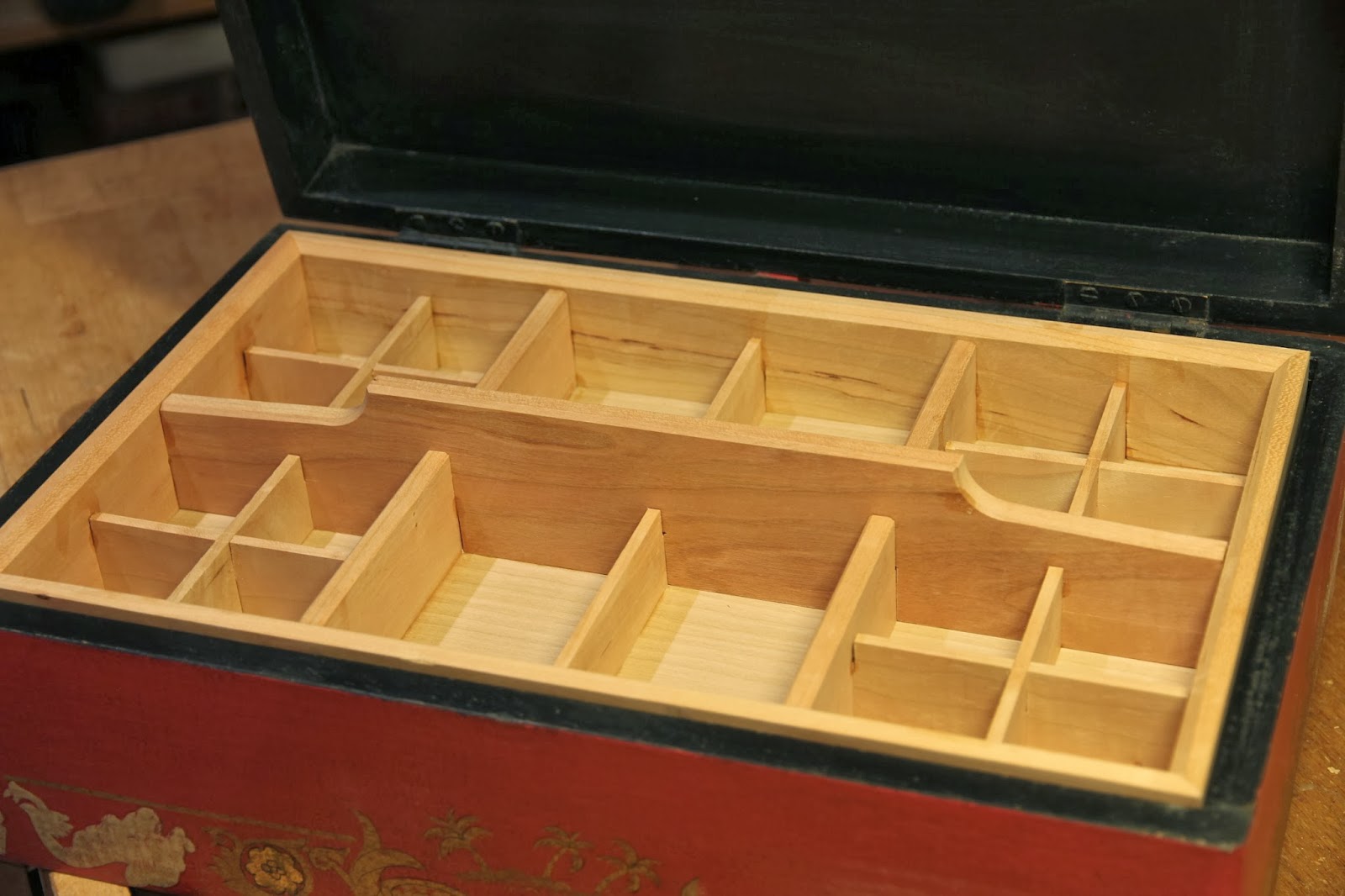
I was asked to convert an old Chinese box into a jewellery cabinet by making a partitioned tray to create individual storage areas housed in the upper part of the cabinet.


The inside was traditional black lacquer and the client had originally asked for the inset tray to be black also. I felt it would look more attractive if left in a natural oiled finish to contrast with the black.


I had some offcuts of American Cherry and thought this would be suitable when oil finished so prepared stock in the usual way for a 50mm deep tray with 30 and 40mm high dividers and a central lifting handle.


I began with the handle and modified an existing jig to shape the curves using a router spindle in the moulder. This was also the first outing for the Bessey automatic hold down clamps which accommodate any thickness of timber without adjustment - very clever.


This is a very quick and accurate way of making multiple parts but, in this case, was fine for a one off.


The shaped handle, ready for chamfer details.


Next job was to trim the sides to length and mitre the ends using a home made mitre shooting board which works well. I use a low angle, bevel up, Jack plane to trim the ends and this produces a fine finish on the end grain and is easy to push.


I could have routed the housings for the dividers but didn't have a 4mm router bit to hand and so sawed the edges at an angle and cleaned out with a variety of chisels. This also avoided the terrible row routers make leading to a more peaceful process.


Similarly I worked the rebates with a skew rebate plane (an excellent and effective tool), paired with a left handed skew block plane, where the grain ran contrary. I find this pairing of planes covers all eventualities in grain direction, plus rebating or block planing as required. I ran a chamfer along the top edges to thin down the appearance from above.


The skew block plane and rebate and chamfer details.


The glue up was simple with just plain mitres and I used corner blocks to apply even pressure to the joints, held in place with an aerolastic (not rocket science).


Once dry I strengthened the corner joints with skewed splines. Again I had an existing jig for use on the table saw or spindle and I used this on the table saw to cut opposing slots at an 8 degree angle. I cut the far slot first then flipped the frame and cut the second slot this ensuing that the spacing was even.


The slots cut ready for the inserts. They look a bit like dovetails to the casual observer so add interest to the piece. The splines will be 45 degree grain so will generally end up as a darker contrast when finished, a nice detail.


Glued up and cleaned off


For the base I had some 6mm veneered ply but this was a little too thick for the size of the tray so I put it through the thicknesser down to 3mm. I was lucky the intermediate plies were fairly good and continuous which is not always the case with modern plywood. One common problem with plywood is that it is not flat and I ended up sitting the assembled tray on blocks and clamping with holdfasts from above while the glue went off. 


I left the tray unfinished, pending inspection by the client but hope they will accept an oiled finish which always looks good on cherry.


As usual I learned a lot during the construction and, on reflection, I think the central handle looks a bit heavy, I could have pierced it or run a mould down each side but I am pleased with the outcome and hope the client is too.


The one that got away. A nasty gap in one of the dividers!! You wonder how this can happen.


Apart from the "gap" I am pleased with the finished job which I exposed to daylight for a week to darken the cherry to compliment the red outside.


Saturday, 14 December 2013

Krenovian carving knife

Krenov carved many of his cabinet handles and catches freehand using a range of small knives he made as required. I stumbled across some very nice nickel steel blades at a woodwork fair in Harrogate by Nic Westerman of Machynylleth and bought a couple. The handle was made from some very old English walnut salvaged from firewood cut from ancient walnut plantations in South Derbyshire where it was once common. In this case it was from the estate of Elvaston Castle south of Derby.

I carved and rasped the organic shape until it felt comfortable with sufficient shape to allow close control over the blade. Finish was oil and wax.


It's off later today as a secret santa present so I'll have to make the other blade for myself later.

Tuesday, 10 December 2013

Boring Bars - not an anti drinking comment

Spent today making some boring bars for work on the ML7. I use a piece of 8mm HSS to make a cutter which I mount in a square hole drilled and filed in the bar and retained with a 6mm screw from below. Today I had to run down some 25mm stock and tried the travelling steady to control chatter. In practice it worked very well.


Sunday, 24 November 2013

Rebuilding a Brompton Folding Bike

My 2000 vintage Brompton L5 had had a hard life in a boat locker and was already in a sorry state when the 5 speed Sturmey Archer finally gave up on a hill in the Isle of Man . A quick Google revealed that there was an 8 speed conversion available from Kinetic bikes in Glasgow so an order was placed and a general refurbishment undertaken.

Stripping down for stove enamelling proved to be a little challenging as the countersunk screws which secure the pivoting rear frame are Locktited in and had to be drilled out. The pin and bearings were in perfect condition so I tried to order replacement screws and spacer washers from a Brompton agent. This proved impossible as Brompton only supply a complete kit. I complained to Brompton who put me in touch with the head mechanic, however his information later proved to be incorrect, as the design of the spacer washers and possibly the pivot arrangement had changed and they appear to have no records of production amendments. Little did I know that this story was to repeat at every stage in the re-build.

I found an excellent stover in Burton on Trent, T Ward Ltd, who filled the corrosion and produced a superb result in rhubarb and custard colours. The finish was incidentally much better than my wife's recently purchased Brompton Superlight.


I reassembled the swinging frame first and added the current locking catch which prevents the bike folding when lifted plus a harder rear spring.

I needed a new headset and selected the lighter alloy version from the spares list. Again this did not fit as the spigot length was longer than the counterbore in the steering tube. Fortunately I was able to put the cup in the lathe and reduce the length to suit (but should you have to do this)?


I then moved on to the seat pin. This is retained by a plastic inset which I renewed as the old one had broken on removal (it is glued in place). The packet arrived containing two bushes, a common occurrence with Brompton spares, along with instructions for fitting. The resulting bore was significantly too small for the seat pin and required reaming to fit, which was not mentioned. Not everyone has access to a 1 1/4" reamer but fortunately I was able to borrow one and finished the job.

The kit from Kinetic proved excellent with an amended chain tensioner, smaller chain set, and comprehensive fitting instructions. All went well. This pic shows the Kinetic modification in the folded position.


This is the bike in running mode with the new smaller chain set to achieve the required gearing. There is a low 1st and high 8th with 6 closely spaced intermediates, about perfect for commuting and touring.


I moved the the handlebar group and found that the new brake cables not only did not fit the levers but there was an instruction that the levers must be replaced at a cost of £27. This is presumably owing to a design weakness but typically Brompton ask the client has to pay

The job was finished with a new seat, bar grips and lights.


Despite their dreadful failings in client support Brompton are an excellent example of the adage "design is all" as the original concept is still way ahead of the nearest rival.


 Re-united with it's sister Superlight for a shake down run on Derby's cycle lanes.


I am delighted with the end result being a unique customised folder which is ideal for commuting.

I am astonished by the ineptitude of Brompton, who clearly have no concept of legacy support, and may even be lacking the necessary data, if not, it is certainly withheld from clients. I suppose this is par for the course for a darling of the Tory party, who have featured them several times in a pathetic attempt to persuade us we are still in the forefront of manufacturing industry and innovation. Unfortunately my experience is also in line with Tory philosophy of sell it now with little care or concern for the future.

Thursday, 5 September 2013

Voyaging from Conwy to the Clyde on Jacana (Malo 38 #212)

We decided to move our base up to the Clyde to access the Scottish West coast so arranged a transfer from Conwy to Rhu marina, which happen to be run by the same company.

We originally intended to move in June, to have the best of the weather on the West coast, but turbo problems on the boat delayed us until the last week in August, which is often notoriously windy from past experience.


These trips always start with a blood letting session from the diesel tank to drain off accumulated water before it leads to diesel bug which is a nightmare to eradicate.


Once underway we spent a final and, as it turned out, rather uncomfortable, night at our favourite anchorage at Puffin Island off Anglesey.


The lighthouse marking the Menai


As is often the case, a rough night ois followed by a flat calm day and the sea was a mirror-smooth, meaning we had to motor all the way to the Isle of Man. We decided to head for Port St Mary on the Southern tip as it is all tide and allows freedom to select the best time to transit Calf Sound to the West side of Man.


Port St Mary is no happenin' place and I dread to think what teenagers find to do but it is a quiet and beautiful place in the right weather. In bad weather it is a place to be avoided as the swell bounces around the harbour and can be dangerous.


We were not exactly fighting for a place


This shows a cloud cap leaving the mountain tops to the West which indicates a wind shift from N to W.


 The run down to Calf Sound has some very attractive cliffs and rock formations, only visible from the sea.


Made it to Peel, our favourite holiday port. Lots of tea drinking and cycling followed and we took a look at practice for the Manx GP which was taking place. As you can see Ro likes her new cycling helmut to go with her retirement present (to herself), a titanium Brompton Superlight.


I managed to strip first gear on my (gas pipe version) 5 speed Brompton which, of course I put down to superior power, rather than loading! Every cloud......... it seems there is now an 8 speed Sturmey Archer hub, which was duly ordered from Kinetic in Glasgow and hopefully should be ready by the time we get back.


The next stage was a bit more challenging from the sailing point of view, up the North Channel, Mull of Galloway, East of the Mull of Kintyre across the bottom of Arran to a safe harbour at Lamlash on the East side of the Island. We decided to break the journey at Port Patrick, near Stranraer, on the side of the North Channel, which owes it's existence to shipping Redcoats, who had previously marched up from London, over to Ireland to suppress the natives. It is only about 20m over to the Emerald Isle.


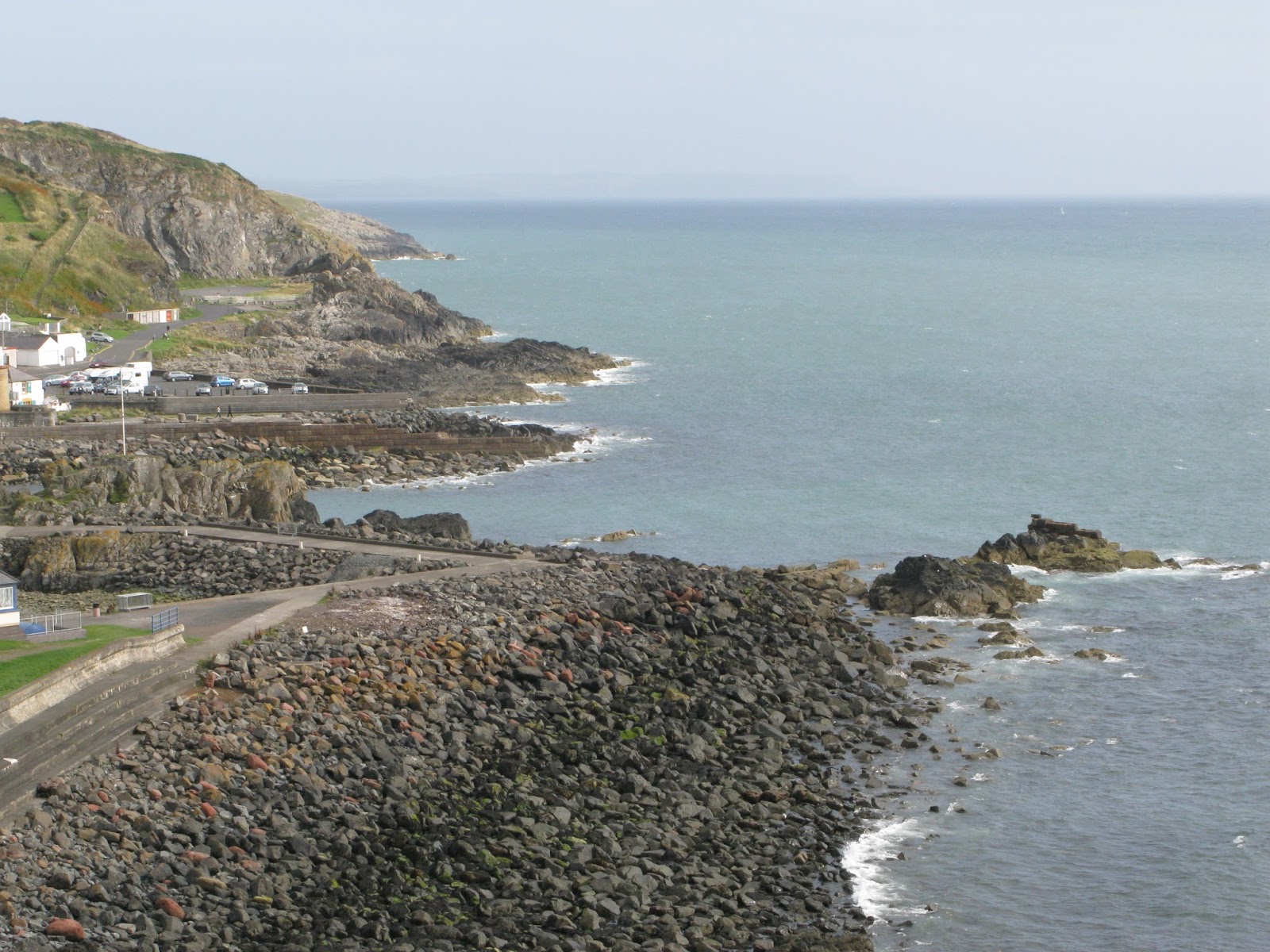
All started well with a fast sail on a beam reach to the bottom end of the North Channel but then the wind got up and the sea with it and we had a bumpy ride for the last few miles. The entrance above is very narrow and there are strong cross tides and breaking swell as the depth shallows. We found the leading lights and locked onto it grimly as we pitched in.


Once in we tied up to the harbour wall with only a couple of other boats in dock. Regretfully we were tempted by the quayside chip van and I can only conclude there was fresher oil in our sump.

Portpatrick proved to be a pleasant surprise thereafter with some impressive local scenery and coastal walks and a Draculean hotel on top of the cliff.


The beach was littered with Jellyfish and we couldn't decide if they were dead or alive. Either way there were dozens of them.


The weather, which had stayed fine so far, now showed definite signs of deteriorating so we decided to pitch for a gap before a forecast F8 storm to the proven shelter of Lamlash on the Isle of Arran.

We got off to a good start but quickly had to don full gear (including Ro's new buff to match her bike!)  as the wind and rain set in.


Along the way we passed Paddy's Milestone (Ailsa Craig) on which I landed 48 years ago on a school cadet trip. We were in an increasing Westerley wind but it was on the beam so no trouble.


Pictures now stop for two reasons, one, I dropped my camera and broke it and secondly the conditions continued to deteriorate with the wind rising to a 7 gusting 8 and a sea to match, especially just South of Arran. We bashed on under double reefed sails with some large breaking waves knocking us off course from time to time but Jacana is a good sea boat and coped well with the conditions. In fact we were flying with a max of over 9 knots, well above the theoretical max speed of the hull. Basically it is surfing..........sounds fun, but it wasn't.


Worse was to come when we arrived at Lamlash. We had stayed here before in mild conditions and it is supposed to be an all weather harbour. The wind was now gusting 35+ knots and we moored to a buoy in the bay. I used the standard procedure of lasooing a buoy and pulling it alongside to pass a rope through the eye, leaving the lassoo rope as a insurance. This proved to be a mistake as Even though I balanced the load on both ropes it chafed through at 01.00 in the morning. Fortunately, in this case, sleep was impossible and I heard the remaining rope straining and got up to investigate.

The scene which greeted me was not a happy one with ragged rope ends hanging off either side of the bow and the sole remaining line near breaking point. I roused Ro who drove the boat up to the buoy whilst I managed to hang over the side a thread a second line through the eye. I then drank tea for the next two hours in order to check that the new arrangement would not chafe through before finally getting to sleep at 04.30. The wind never dropped  below 30 knots all night and showed a F8 on the dial when the line failed.


Lesson learned don't leave the lassoo line on!!

Typically all was calm by breakfast, in fact it was a beautiful morning, and we set off for the Clyde.


It was still a bit squally so we alternated reefed sails and motoring to sail up the Clyde to our new home at Rhu. This proved to be a tranquil delight with plenty of space and friendly, helpful staff and natives (although I think the name helps a bit :-))


All in all, an interesting and challenging trip. We are looking forward to exploring the West coast of Scotland and Islands.